
ISSN 1728-2985
ISSN 2414-9020 Online

Сравнение международного индекса симптомов при заболеваниях предстательной железы и визуальной шкалы симптомов заболеваний предстательной железы у пациентов в Турции

S. Caliskan, M. Sungur

1 Научно-образовательный госпиталь Kanuni Sulta n Süleyman, Урологические отделение, Стамбул, Турция; 2 Университет Хитит, Научно-образовательный госпиталь Çorum Erol Olçok, Урологические отделение, Чорум, Турция
Введение. Доброкачественная гиперплазия предстательной железы представляет собой одно из наиболее распространенных заболеваний у мужчин пожилого возраста. Оно, как правило, сопровождается развитием симптомов нижних мочевых путей, включая учащенное мочеиспускание, ургентность, ноктурию и прерывистую струю мочи. В повседневной клинической практике при опросе обычно используют шкалы симптомов заболеваний предстательной железы. Целью нашего исследования было сравнить Международный индекс симптомов при заболеваниях предстательной железы (IPSS) и Визуальную шкалу симптомов заболеваний предстательной железы (VPSS) у пациентов в Турции. Материалы и методы. Исследование проводилось с января по август 2017 г. В него вошли пациенты с симптомами нижних мочевых путем в возрасте старше 45 лет. Проводился анализ возраста, уровня простатического-специфического антигена (ПСА), уровня образования и показателей опросников. Критериями исключения были неврологические заболевания, операции на предстательной железе, лучевая терапия и злокачественные опухоли любой локализации в анамнезе. Результаты. Всего в исследование включен 81 пациент. Средний возраст и уровень ПСА составили 58,86±7,39 года и 1,94±1,77 нг/мл соответственно. У большинства (54,32%) пациентов было неполное среднее образование, у 19,75% – высшее. Кроме того, 12,34 и 13,58% больных соответственно имели второе высшее и среднее образование. Показатели полного заполнения опросников составили 37% для шкалы IPSS, 9,8% для VPSS и 81% для CSS (p<0,05). У пациентов, полностью заполнивших опросники, не отмечено статистически значимых различий в зависимости от уровня образования и возраста. Заключение. Шкалы IPSS и VPSS являются валидизированными для оценки симптомов у пациентов с доброкачественной гиперплазией предстательной железы. Имеются трудности в понимании и проблемы с переводом этих опросников; необходимо разработать новые оригинальные опросники на родном языке для пациентов в Турции.

Ключевые слова

симптом
предстательная железа
опросник

Introduction. Benign prostate hyperplasia(BPH) is the most common benign disease in American men [1]. Aproximetely, BPH affects 75 and 83% of the men in the seventh and eigth decade of life respectively. The patients with BPH usually present lower urinary tract symptoms (LUTSs). The LUTSs include storage, voiding and postvoiding associated symptoms and are seen in 30% of the men over the age of 65 years [2]. In 1992, the World Health Organization accepted to use symptom score which was developed by American Urological Association [3]. This symptom score was called International Prostate Symptom Score (IPSS) which includes seven questions about bladder emptying, frequency, intermittancy, urgency, weak stream, nocturia and straining [4]. A new symptom score was developed by Walt et al in 2011 that was called Visual Prostate Symptom Score (VPSS) [5]. The VPSS has advantages about simplicity and easy understandable for elderly men when comparing the IPSS [3].

In this stuy, we aimed to compare the answering of IPSS and VPSS for the patients presenting with LUTS in urban area (Çorum city) of Turkey.

Methods. Data were recorded prospectively from the patients who were admitted to Hitit Universtiy, Çorum Erol Olçok Training and Research Hospital for LUTS over the age of 45 years from February to August 2017. The patients were requested to fill the IPSS and VPSS without any assistance. The IPSS included 8 questions for irritative symptoms (2, 4, 7. questions (Qs)), obstructive symptoms (1, 3, 5, 6 Qs) and quality of life (8.Q); VPSS consisted 4 pictograms; 1 and 2 for irritative symptoms, 3 for obstructive symptom and 4 for quality of life. The education level, age and PSA level of the patients were noted. The questionnaires were evaluated for the patients completed or not with themselves. The patients who had history of prostate surgery, urethral stricture, radiotherapy and neurological disorders were excluded from the study.

The statistical analyses were performed using MedCalc Statistical Software demo version 16.2.0 (MedCalc Software bvba, Ostend, Belgium; https://www.medcalc.org; 2016). The data was expressed as mean+standard deviation and chi squared test was used for percentage, p value <0.05 was considered as statistically significant.

Results: There were 81 patients in the study. The mean age of the patients was 58.86±7.39 years. The education levels and demographic characteristics of the patients are shown in

Table 1. According to the Turkish education level; primary school (5 years), secondary school (8 years), high school (12 years) and university. 44 patients had primary, 10 had secondary and 11 patients had high school education level. There was 16 patients who had graduated from university.
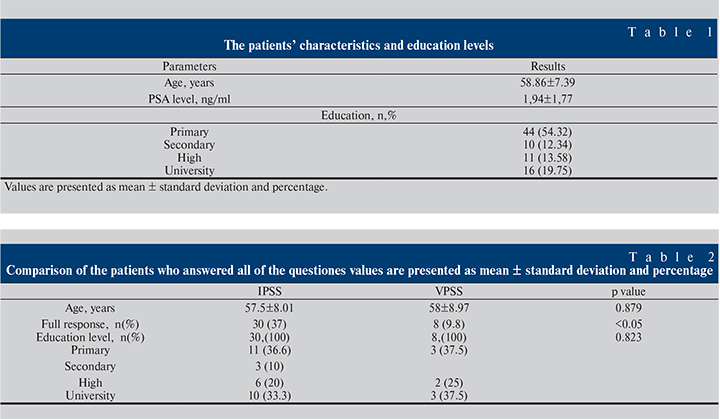
The IPSS and VPSS questionnaires were completed by 30 and 8 patients without assistance respectively. Table 2 shows the comparison analysis between VPSS and IPSS for the education levels of the patients about full complete. There was no significant difference for education level between the full complete response of questionnaires (p=0.823).

Discussion: Benign prostate hyperplasia associated LUTS is very common problem in middle age or older men [6]. The IPSS is a useful questionnaire for evaluating the severity of LUTS and treatment efficacy of BPH in follow up [7]. Therefore guidelines recommend that IPSS can be used in the evaluation and follow up period for LUTS and BPH. The IPSS includes 8 questions; the first 7 questions were to evaluate storage and voiding symptoms and the patients choose 1 to 5 point in every question [3]. The final question is about quality of life. The symptom score ≤7, 8–19, ≥20 are classifed as mild, moderate and severe symptoms. But, most patients with a low education level can not answer the IPSS questionnaire correctly, eyesight related and cognitive problems are negative factors after the age of 50 years [6]. The patients usually ask questions the health workers for the explanation of the question because of its complexity [3]. To overcome the problems, a new symptom score that called VPSS was developed by Walt et al using 4 pictograms [5]. The advantages of VPSS are simpler and easier to understand for elderly men than IPSS [3]. The pictograms represent frequency, nocturia, weak stream and quality of life.

The authors investigated the correlation between VPSS and IPSS, found that 91.3% and 77.9% (p<0.05) of the patients completed the VPSS and IPSS respectively [7]. In another study from Indonesia, the authors reported that VPSS was completed much more than IPSS [3]. Taneja et al, found that 89 patients(80.9%) completed VPSS but only 48 patients(43.63%) could completed the IPSS [6]. The education level of the patients; 54.5% was Grade 9. The authors from Turkey reported the complete answering rate of IPSS and VPSS was 87.1–97.6% [8]. In study design, they gave the questionnaires to the patients and they filled the forms in home without time restriction. Maybe they completed the forms with assistance, because the answer rate was higher than the literature. Ceylan et al, reported the complete answering the IPSS and VPSS without help was 44.5 and 84.3% respectively [9] In the present study, 30 patients fully completed (44.4%), partial complete rate was 44.4% , 15 patients (18.5%) had no answer for the IPSS form. The answering the IPSS was 81.5% which is similar in the literature, but only 44.4% of the patients fully completed answering all of the questions.The IPSS which is the most preferable method for to evaluate the LUTS in men, was translated into several languages but still needs validation studies [9]. There are limitations to use IPSS in patients with limited education and illiterate [10]. Additionaly the elderly men have difficulties to read small print when answering the questiones [9]. The other disadvantages are lack of to evaluate the incontinence, pain and macroscopic hematuria. The VPSS gives objective measurement for LUTS especially in men with low education level [9]. Because this symptom scorre includes 4 pictograms that are easily unserstandable [3]. We could not afford this finding in the current study; only 9.8% of the patients fully completed the questiones and most of the patients (58%) could not understand the pictograms of VPSS. The writing explanation may be alternative for VPSS that increases the complete answering rate.

The limitations of the current study are small patient group from one single center. The other limitaion of the study is the education level of the patients. The education level can not be similar in the population

In conclusion, we think that there are some problems to understand for IPSS and VPSS for Turkish patients. New and easily understandable questions must be preperad for using national language to understand well.


Список литературы

1. Selekman R.E., Harris C.H., Filippou P., Chi T., Alwaal A., Blaschko S.D., Breyer B.N. Validation of a Visual Prostate Symptom Score in Men With Lower Urinary Tract Symptoms in aHealth Safety Net Hospital. Urology. 2015;86(2):354–358.

2. Çalışkan S., Keleş M.O., Öztürk M.İ., Kutluhan M.A., Tok O.E., Ercan F., Karaman M.İ. Effect of sildenafil citrate in testosterone induced benign prostate hyperplasia rat model. Turk J Urol. 2017;43(4):434–438.

3. Afriansyah A.,Gani Y.I., Nusali H. Comparison between visual prostate symptom score and international prostate symptom score in males older than 40 years in rural Indonesia. Prostate International. 2014;2(4):176–81.

4. Abiola O.O., Ajape A.A., Adeniyi S.O., Ayeni S.C. Use and ease of self-administered International Prostate Symptom Score (IPSS) and Visual Prostate Symptom Score (VPSS) questionnaires fort he assessment of lower urinary tract symptoms in Nigerian men. African Journal of Urology.2016;22:121–16.

5. Walt C.L.,Heyns C.F.,Groeneveld A.E., Edlin R.S., Vuuren S.P. Prospective comparison of a new visual prostate symptom score versus the International prostate symptom score in men with lower urinary tract symptoms.Urology. 2011;78:17–20.

6. Taneja Y., Ram P., Kumar S., Raj K., Singh C.K., Dhaked S.K, Jaipura J.Comparison of Visual Prostate Symptom Score and International Prostate Symptom Score in the evaluation of men with benign prostatic hyperplasia: A prospective study from an Indian population. Prostate International. 2017;5:158–61.

7. Park Y.W., Lee J.H. Correletaion Between the Visual Prostate Symptom Score and International Prostate Symptom Score in Patients With Lower Urinary Tract Symptoms. Int Neurourol J. 2014;18:37–41.

8. Guzelsoy M., Aydos M.M., Coban S., Turkoglu A.R., Acibucu K., Demirci H. Comparison of the effectiveness of IPSS and VPSS without any help in LUTS patienst. a prospective study. The Aging Male.2017.

9. Ceylan Y., Gunlusoy B., Değirmenci T., Kozacıoğlu Z., Bolat D., Minareci S.Is New Visual Prostate Symptom Score Useful as International Prostate Symptom Score in the Evaluation of men With Lower Urinary Tract Symptoms?A Prospective Comparison of 2 Symptom Scores in Turkish Society. Urology. 2015;85(3):653–57.

10. Stothers L., Macnab A., Bajuniewe F., Mutabazi S., Lobatt C. Comprehension and construct validity of the Visual Prostate Symptom Score (VPSS) by men with obstructive lower urinary tract symptoms in rural Africa. CUAJ. 2017;11:405–08.

Об авторах / Для корреспонденции

Автор для связи: Selahattin Çalışkan – Atakent Mah. 1.Sk. No:46. 34303 Küçükcekmece. Стамбул, Турция; e-mail: dr.selahattincaliskan@gmail.com

Также по теме