
Introduction. Prostate adenocarcinoma is the second most common cancer in men and prostate biopsies are required to establish the diagnosis of prostate cancer. The vast majority of prostate biopsies are still performed using the conventional transrectal (TR) approach [1]. However, in recent years transperineal (TP) approach has gained popularity due to the avoidance of passing the biopsy trocar through the rectum into the sterile field of prostate. The TR approach could cause the inoculation of rectal bacteria into the bloodstream leading to septicemia. TR biopsy sepsis can be life-threatening with a reported mortality rate of 0.13% [1, 2].
Furthermore, the standard practice of giving prophylactic antibiotics, typically fluoroquinolone has led to increasing multi-drug resistant bacteria causing a higher post-TR biopsy infection rate [1, 3]. Hence, TP approach was developed to overcome these problems. Numerous studies have reported the risk of sepsis in TP approach is almost negligible, 0–0.2% as the access is through the clean perineal skin [4, 5]. However with presence of medical comorbidities, particularly diabetes, metabolic syndrome or immunocompromised patients are independent predictors of increasing risk of sepsis [6].
Post-prostate biopsy bleeding, voiding dysfunction, and pain are common but not clinically significant and rarely bothersome. There are patient-related factors (comorbidities, use of antiplatelet/anticoagulants, prostate volume, anxiety) and procedure-related factors (techniques, number of cores) may influence these complication rates [7]. Rectal bleeding, hematuria or hematospermia has been reported with rates ranging from 2–84%, with bleeding lasting for more than 3 days reported in 22.6% of cases. However, severe bleeding requiring hospital admission was <1% [8].
Few data reported the post-biopsy related worsening of lower urinary tract symptoms is common ranging from 6–25% [7, 8]. These symptoms are usually transient with reported return to baseline within 6 week. Acute urinary retention rate is reported to be higher in TP approach ranging from 1.7 to 11.1% [9]. However, its self-limiting which may or may not require catheterization.
Post-biopsy transient erectile dysfunction was also reported with complete recovery after 1–3 months [10]. Some studies have shown that 34% of patients with no ED at baseline before the procedure had a decrease in the International Index of Erectile Function (IIEF) score at 1 week [11].
The detection rate of clinically significant cancer in the TP approach is at least equivalent to TR biopsy and various studies have shown that TP biopsy offers better yield in the tumor located anteriorly [12].
TP prostate biopsy is associated with a higher pain score due to the approach through the highly sensitive perineal skin and exaggerated lithotomy position during the procedure, therefore this approach is usually performed under regional or general anesthesia. However, many studies have shown TP approach is generally well tolerated under local anesthesia by most patients with more than 90% of patients able to complete the procedure and would recommend this procedure to other patients [13]. Pain may arise in different steps of the procedure such as probe insertion and manipulation, during infiltration of local anesthesia to the perineal skin or periprostatic block and during sampling of the prostatic tissue [8]. Hence various techniques were suggested for optimal pain control during and after the procedure to achieve the best outcome of biopsy yield and improve patients’ acceptance of this procedure.
In Malaysia, TP prostate biopsy is not widely performed as TR approach owing to the relatively high technical difficulties and lack of equipment. Many centres that performed TP prostate biopsies were done under general or regional anesthesia as the main concern of this approach is pain. Hence, the urology department of Hospital Sultan Abdul Aziz Shah UPM would like to prove that TP approach can be done under local anesthesia with at least an equivalent cancer detection rate and lower infection-related complications when compared to TR biopsy.
Methodology. A prospective study with 128 of total patient were recruited to receive prostate biopsy at our centre Hospital Sultan Abdul Aziz Shah UPM from March 2021 to December 2022.
A total of 128 patient are eligible were included. Sixty four patients were taken into each arm. All patient enrolled in this study were given writing and informed consent. All data regarding procedure and medical data were collected and analyst. Main Inclusion criteria including abnormal digital rectal examination, elevated PSA level above 4ng/mL, not catheter-dependent patient regardless patient had previous experience of biopsy in difference center before and any patient with previous history of prostate cancer before that required repeated biopsy (active surveilliance). For exclusion criteria, any patient who are not able to tolerate local anaesthesia requiring sedation or conversion to regional/general anaesthesia were excluded. Other than that, patient with abnormal skin and condition that can exaggerate pain such as previous perineal or rectal surgery, previous pelvic radiotherapy, perineal skin abnormalities (e.g. active infection, tumor) are excluded. Patients who are not able to be in lithotomy position for at least 45 minutes as assessed by clinicians, are also excluded from this study. The patients were clearly and concisely informed of the benefits and the risk separately from the TP and TR biopsy procedures via an oral explanation, and the letter of their consent was acquired.
All patient that underwent TP biopsy under LA with MRI – Fusion guided biopsy using Trinity Koelis software system and MRI image are contoured prior to procedure. Patients underwent TRUS biopsy using BK ultrasound system.
Biopsy protocols:
Transrectal (TR) prostate biopsy:
Patient will be placed on left lateral position. A DRE is performed for clinical evaluation of the prostate, noting the size, consistency, any presence of nodules and clinical T stage if there is suspicion of malignancy. Rectal washout with povidone solution. Ultrasound probe will be adequately lubricated prior to insertion and biopsy gun placed through transrectal ultrasound. Periprostatic nerve block with 2% - 10 ml lignocaine will be given first at the bilateral prostate apical area where major neurovascular bundle traverses through using ultrasound guided. Generally 12 core biopsies from apex-mid plane, basal peripheral zone including the far lateral area and from bilateral transitional zone (TZ) via the probe guided-side fire device. The number of biopsies may vary according to the prostate volume or additional suspicious transrectal ultrasound findings.
Transperineal (TP) prostate biopsy :
Prior sending patient to procedure room, EMLA cream is given over perineum area as a standard procedure. Once in procedure room patient will be placed on lithotomy position. Foleys catheter is inserted to allow guidance for the identification of the urethra. A digital rectal examination is performed for clinical evaluation of the prostate, noting the size, consistency, any presence of nodules and clinical T stage if there is suspicion of malignancy. The scrotal tape is applied to elevate and held out of the way to expose the perineum. Excessive hair will be shaved off the perineum. The perineum is prepared using Betadine (7.5% povidone-iodine) or other equivalent antiseptic solutions and draped under aseptic technique.
A dilution of 20ml 0.5% Marcaine adrenaline, 10ml 2% lignocaine and 50mls of water is prepared. Approximately 10mls of the cocktail will be injected with fanning method to numb the perineal skin. A well lubricated ultrasound probe will be inserted into the rectum to visualize the prostate gland and the remaining cocktail will be given generously at the periprostatic region under the guidance of the ultrasound. Image from ultrasound probe will fuse with MRI contour images in the system by radiologist. Image contouring performed by surgeon in charge intraoperatively. Once acceptable countering image done, targeted lesion will visible in the system. Targeted biopsy and systemic biopsy performed. The number of core biopsy in targeted lesion depends on size of the lesion. Standard 12 core systematic biopsy were also performed once all targeted lesion completely obtained.
Data collection
Once the procedure is complete, patients are required to rate their pain on VAS, numbered 0–10 with 0 being ‘No pain’ and 10 being ‘Worst pain’. Patient will then be observed for a few hours for early complications. Patients will need to complete the given questionnaires before discharged home.
Patient will be advised on the common complications that may arise after the procedure. All patients will be informed on the signs and symptoms of infection, bleeding (rectal bleeding, haematuria, haematospermia), acute urinary retention and are advised to seek for medical attention in the nearest hospital if developed any of the complications. Patients will be allowed home as soon as they are able to void after the procedure and will be reminded to complete the antibiotic regime in the TR group.
Patients will be given a follow up on day 14 post-procedure to assess pain score using VAS, urinary function using IPSS score, erectile function using IIEF-5 score and interviews on any complications that occurred within this 14 days period. Patients who were not able to attend the clinic appointment on day 14 will receive a postoperative phone call questionnaires.
Sample size
VAS score was used to determine the primary outcome of this study. To estimate the sample size, Gpower calculator was used. It would require 64 patients for statistical power of 80% to detect this difference and predicting a 10% exclusion rate.
This sample method also can be calculated using formula N = 2ơ2/∆2 (Zα+Zβ)2
Universal sampling was used to determine the sample distribution.
Statistical analysis
A comprehensive analysis of the study data involved both descriptive and inferential statistical approaches. Descriptively, simple frequencies and percentages were computed for sociodemographic characteristics, PSA levels, prostate volume, and complications. The distribution of continuous variables was assessed for normality using the Shapiro-Wilk test. For normally distributed data, means and standard deviations were presented as measures of central tendency and dispersion, respectively. Non-normally distributed data were summarized using the median and interquartile range (IQR).Inferentially; statistical tests were selected based on the normality of the data. For normally distributed variables, the independent sample t-test was employed; while non-normally distributed variables were analysed using the Mann-Whitney U test. The choice of these tests ensures robust analyses suitable for the varied nature of the dataset. Furthermore, Difference of categorical variables between two groups was explored using Fischer’s Exact Test. The significance threshold was set at a p-value of 0.05 or less, accompanied by a 95% Confidence Interval. All statistical analyses were executed using SPSS Software, specifically version 27.0.1, developed by IBM.
Result. The study involved two distinct groups, the Transperineal (TP) group, comprising 64 participants, and the Transrectal (TR) group, also consisting of 64 participants. The mean age of participants in the TP group (M=66.2, SD=4.8) was found to be significantly lower than that of the TR group (M=69.4, SD=5.8), with a statistically significant difference (p=0.001) see Table 1.
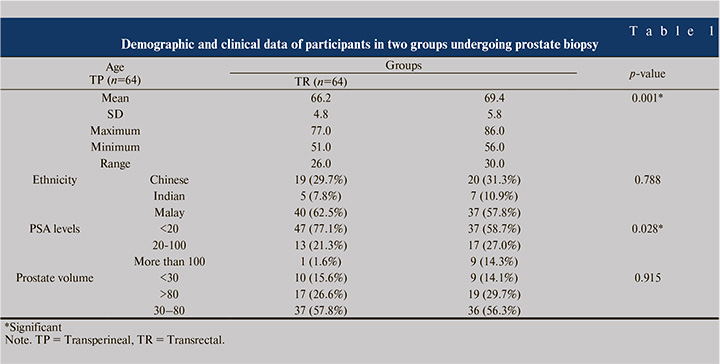
The distribution of ethnicities in the TP and TR groups is presented in Table 1. The majority of participants in both groups identified as Malay, constituting 40(62.5%) in the TP group and 37 (57.8%) in the TR group. The Chinese ethnic group accounted for 19 (29.7%) in the TP group and 20 (31.3%) in the TR group. The Indian ethnic group represented 5 (7.8%) in the TP group and 7 (10.9%) in the TR group.
A chi-square test revealed that the distribution of ethnicities did not significantly differ between the TP and TR groups (χ²=.476, p=0.788).
Table 1 provides a comparison of PSA levels and prostate volume between the TP and TR groups. In the TP group 47 (77.1%) of participants had PSA levels below 20, while in the TR group, this percentage was 58.7%. For PSA levels between 20–100, the TP group had 13 (21.3%), and the TR group had 17 (27.0%). The category of PSA levels more than 100 showed 1 (1.6%) for TP and 9(14.3%) for TR. The difference was statistically significant (χ²=9.124, p=0.028).
Regarding prostate volume, there were no statistically significant differences between the groups. For prostate volume below 30, the TP group had 10 (15.6%), and the TR group had 9 (14.1%). Prostate volume above 80 was observed in 17 (26.6%) of the TP group and 19 (29.7%) of the TR group. Prostate volume in the range of 30-80 was recorded in 37 (57.8%) of the TP group and 36 (56.3%) of the TR group.
Table 2 presents a comparison of pain scores during the procedure between the TP and TR groups. The median pain score for the TP group was 2, while the TR group had a median score of 3. Percentile 75 (Q3) for both groups was 4, and Percentile 25 (Q1) was 2. The interquartile range (IQR), calculated as Q3 minus Q1, was 2 for both groups. The maximum pain score recorded was 7 in both groups, with the minimum score being 0 in the TP group and 1 in the TR group. The statistical analysis revealed a non-significant difference in pain scores between the TP and TR groups (Mann-Whitney U test=2210, p=0.482).
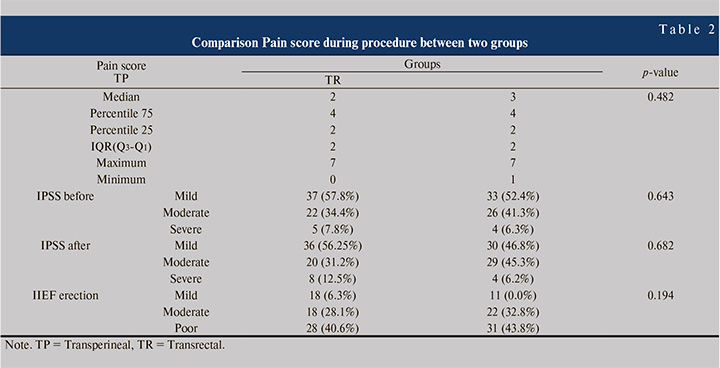
IPSS scores before the procedure indicated that the majority of participants had mild symptoms in both groups (57.8% in TP, 52.4% in TR).No significant difference was found in IPSS scores before the procedure between the two groups (p=0.643).After the procedure, the distribution of IPSS scores remained comparable, with no significant differences noted (p=0.682).The occurrence of worsening LUTS after 14 days was observed in 7% of the TP group and 4.6% of the TR group. IIEF Erection scores showed variability, with no significant differences between the TP and TR groups (p=0.194).The distribution included participants with mild, moderate, and poor erection categories.
Table 3 presents the comparison of complications between the two groups. The occurrence of haematuria was observed in both groups, with 66% in the TP group and 59.4% in the TR group. The duration of haematuria did not significantly differ between the groups (p=0.293), with the majority experiencing it for less than 3 days.
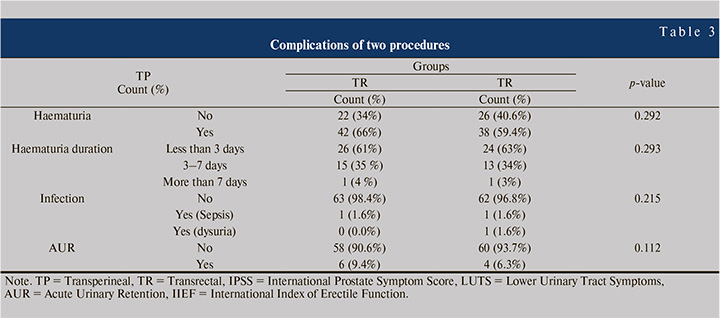
The majority of participants in both groups did not experience infection, with 98.4% in the TP group and 96.8% in the TR group. Infections that did occur were rare and did not significantly differ between the groups (p=0.215).AUR was infrequently reported in both groups, with 9.4% in the TP group and 6.3% in the TR group. No significant differences were observed in the occurrence of AUR between the groups (p=0.112).
Discussion. TR and TP are different approaches for prostate biopsy and it has its own different experience for patients. Perineal can be sensitive and very painful. To minimize the risks associated with general anesthesia, the TP procedure under local anesthesia was introduced. This technique has been practiced and explained thoroughly in Europe and Asia. UPM is the first center in Malaysia to provide this service, but local experience outcomes are yet to be determined. This study aimed to prove that TP under LA is well tolerated, especially in the local Malaysian population. As the first center doing this procedure under LA we are proud to have such many patients and the number growing over time as we found out it is well tolerated. In this study, we compared the pain score of a biopsy procedure to the pain score of TRUS biopsy under LA, which served as our reference for how well the biopsy procedure was tolerated. As shown in Table 1, the median pain score was similar to that of TRUS biopsy under LA. The study by Hogan et al. [13] also reported a median pain score of 2 (IQR4) for TP biopsy, which is consistent with our findings. Similarly, Kum et al. [15] and Stefanova et al. [5] assessed pain using a VAS score and reported mild tolerability.
Malaysia is a multiracial country with 3 major ethnicities. After statistical testing, we can conclude that both group distributions of ethnicities did not significantly differ between the TP and TR.
In terms of functional outcome during presentation, the majority of both groups had mild to moderate IPSS. However, after a follow-up of 14 days post-procedure, 7% of patients in the TP group had worsened their lower urinary tract symptoms (LUTS) by upgrading their IPSS score from mild to moderate, or moderate to severe IPSS. It was speculated that this effect was due to prostate and urethral oedema post-biopsy. The same was true for acute urinary retention (AUR) after the procedure, as a total of 9.4% (N=6) of patients in the TP group had AUR compared to 6.3% (N=4) in the TR group. All patients who developed AUR had poorer initial IPSS scores before the procedure. One patient from the TP group had a failed trial of voiding (TOV) and required TURP during follow-up. However, the rest of the patients who developed AUR in the TP and TR group were able to void successfully after 2 weeks. Additionally, some patients reported improved urinary function after the procedure. Compared with the previous literature on TP biopsy under LA, in terms of AUR our rate is higher when compared to Meyer et al. [14] (4.7%), Kum et al. [15] (0.6%), and Gorin et al. [16] (1.1%). At its inception TP biopsy-related AUR was the main concern; however, the widespread use of α-blockade pre-operatively has mitigated that risk. Please note that the incidence of Acute Urinary Retention (AUR) is higher in our center due to a high number of core biopsies and patients with poor IPSS at the outset of the procedure. It is unavoidable that post-procedure prostate oedema can affect IPSS and increase the risk of AUR.
Majority of patients has moderate to severe IIEF score before the procedure for both groups especially from TR group with almost all of patients are in moderate and severe IIEF. This is mainly due to the advance age of participants in both groups. During follow-up in 14 days, majority of the patient had same sexual function and does not affect their erection. From review meta-analysis done by J. Fainberg et al. [10], prostate biopsy (transrectal )does cause a mild, transient decrease in average IIEF-5 scores at 1-month post-biopsy which resolves at 3 months on average, and average IIEF-5 remains at baseline at 6 months post-biopsy [10]. Few other study have shown similar outcome.
As for infection complications the incidence of urinary tract infection (UTI) is very low. UTI was defined as episode of fever with symptomatic urinary infection symptoms such as dysuria and urinary frequency. TP group had 1 patient develop UTI and 2 patients in TR group. All of the UTI episodes did present few days post procedure and admitted to ward for IV antibiotics and none of the patients had septicemia (Clavien-Dindo 2). These findings tally with other studies suggesting that TP biopsy is associated with very low incidence of sepsis (less than1%) [6, 8, 17].
Haematuria is a common occurrence after both transperineal (TP) and transrectal (TR) biopsy procedures, with an incidence of 67% and 59% respectively. However, most patients in both groups experienced haematuria for only up to 3 days, and none of them required hospital admission due to severe haematuria (Clavien Dindo grade 1). Additionally, none of the patients in the TP group experienced perineal haematoma. Compared to other studies, in our review, none of the other study incidence of haematuria is comparable with the same outcome [3, 13, 16]. It was not the main concern for this procedure and was mostly insignificant complication.
Transrectal (TR) biopsy under local anesthesia (LA) is still the preferred procedure for certain conditions. For instance, patients who are suffering from advanced metastatic disease can benefit from random TRUS biopsy with a small number of core samples to determine the prognosis of their disease. However, transperineal (TP) biopsy is a more accurate and safer alternative to TR biopsy, and most patients should undergo TP biopsy instead. By eliminating the need for spinal or general anesthesia, the cost of the procedure can be reduced. Additionally, more cases can be performed as TP under LA is now a clinic-based outpatient procedure, and this study has shown that it is safe and well-tolerated.
TP approach under Local anesthesia may be new for most of the centers in Malaysia as the majority of the urologist concerns of pain. However, in our hands, both approaches showed a similar, small, and acceptable discomfort. In our opinion, both methods should be become equally familiar to urologists.
We acknowledge that our data collection by chart has its limitation due to the lack of randomization and control. Also, the lack of a direct comparison between the transperineal and transrectal approaches with regard to histological outcomes and resource consumption represents an additional shortcoming of the current study. Ideally, a randomized controlled study of the 2 approaches performed using local anesthesia might address this issue. A few other aspects was not discussed such as the financial and cost difference between both procedures, the number of cores taken, the accuracy of the biopsy, and a number of positive biopsies in comparison of both groups. In the future, this parameter can be highlighted to strengthen this study.
Conclusion. In our center, we found that TP under LA is a safe and well-tolerated procedure among patients. When compared to the TR group, the pain experienced is mild and not statistically significant. Furthermore, there was no difference observed in urology functional and sexual outcome post-procedure. These results suggest that TP under LA can be a viable alternative to general anesthesia, particularly for high-risk patients. However, we recommend further studies with more cases to strengthen these findings.